

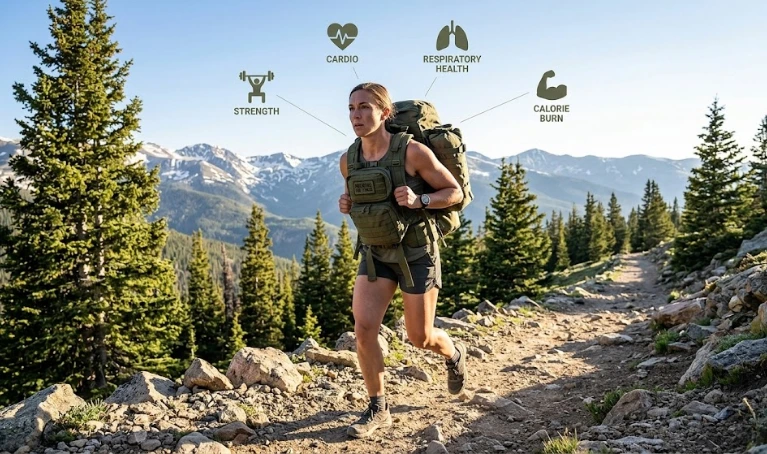
Quick answer: Rucking (walking with a weighted backpack) provides full-body strength training combined with low-impact cardiovascular exercise, burning 30-50% more calories than regular walking while building muscle in your legs, back, shoulders, and core. The most effective approach for beginners is starting with 10-20 pounds (4.5-9 kg) for 20-30 minutes, 2-3 times per week, gradually increasing weight and duration as strength improves.
Most compelling benefit: Unlike high-impact exercises that stress joints, rucking delivers the calorie burn of running with the joint-friendly nature of walking. A 180-pound person burns approximately 400-550 calories per hour rucking with 20-30 pounds, compared to 300 calories walking normally or 600 calories running, but without the repetitive impact that causes knee, hip, and ankle injuries common in runners.
Rucking originated as military training (soldiers carrying heavy packs during marches) but has exploded in popularity as civilians discover its practical, accessible approach to fitness. You don’t need a gym membership, expensive equipment, or special skills, just a backpack, some weight, and a path to walk.
This complete 2026 guide covers the science-backed health benefits of rucking, how it compares to other exercises, muscles worked, getting started safely, common mistakes to avoid, and how to maximize results.
What is Rucking?
Definition: Rucking is walking with a weighted backpack (called a rucksack or ruck). The added weight increases the intensity of walking, transforming it from purely cardiovascular exercise into a combination of cardio and resistance training.
Basic components:
- Walking (your base activity)
- Weighted backpack (10-50+ pounds depending on fitness level)
- Sustained duration (20 minutes to several hours)
- Variable terrain (flat pavement, hills, trails)
Why the military connection: The term comes from military rucksack marches where soldiers train by walking long distances carrying heavy packs (often 40-80 pounds). This prepares them for field conditions while building exceptional endurance and strength.
Civilian adaptation: Modern rucking for fitness typically uses lighter weights (10-30 pounds for most people) and shorter durations than military training, making it accessible while still delivering significant benefits.
12 Science-Backed Health Benefits of Rucking
1. Burns Significantly More Calories Than Walking
The evidence: Adding weight to walking dramatically increases caloric expenditure.
Calorie comparison (per hour, 180-pound person):
- Normal walking (3 mph): ~300 calories
- Rucking with 20 lbs (3 mph): ~400-450 calories (33-50% more)
- Rucking with 30 lbs (3 mph): ~500-550 calories (67-83% more)
- Running (6 mph): ~600 calories
Why it matters: Rucking provides near-running calorie burn without the joint impact, making it ideal for weight loss or maintenance.
Practical benefit: One hour of rucking 3x weekly can create a 1,200-1,650 calorie weekly deficit, potentially leading to 0.5-1 pound weight loss per week combined with proper nutrition.
For those tracking fitness goals and caloric expenditure, using a rucking calorie calculator helps quantify your effort and optimize your training intensity.
2. Builds Full-Body Strength and Muscle
The evidence: The weighted load creates progressive resistance training while you walk.
Primary muscles worked:
- Legs: Quadriceps, hamstrings, calves, glutes (carrying weight uphill especially targets glutes)
- Core: Abdominals, obliques, lower back (stabilizing the load)
- Upper body: Trapezius, shoulders, upper back (supporting backpack)
- Posterior chain: Entire back side of body from calves to neck
How it builds muscle: The constant load requires muscles to work harder than unweighted walking, creating the stimulus needed for muscle growth and strength gains.
Research: Studies show loaded walking increases lower body muscle activation by 20-40% compared to unloaded walking, with core activation increasing even more.
Practical benefit: Unlike isolated gym exercises, rucking builds functional, usable strength in movement patterns your body uses daily (walking, carrying objects, climbing stairs).
Building overall muscular strength and endurance through rucking complements other resistance training approaches for comprehensive fitness development.
3. Low-Impact Alternative to Running
The evidence: Rucking delivers cardiovascular benefits similar to running with significantly less joint stress.
Impact comparison:
- Running: 2.5-3x body weight impact per step
- Rucking: 1-1.5x body weight impact (similar to walking)
Why less impact: Walking gait keeps one foot on ground at all times (no “flight phase”), eliminating the repetitive pounding that causes runner’s knee, shin splints, and stress fractures.
Who benefits most:
- Former runners with joint issues
- People over 40 (when injury risk from running increases)
- Heavier individuals (where running impact is especially harsh)
- Anyone recovering from injury
- Those who dislike running
Practical benefit: Sustainable long-term; you can ruck well into your 60s, 70s, and beyond, while many runners must stop due to accumulated joint damage.
For those looking to maintain cardiovascular fitness through gentler methods, rucking provides an excellent alternative to high-impact activities.
4. Improves Cardiovascular Health
The evidence: Rucking elevates heart rate into cardio training zones while being easier to sustain than running.
Heart rate zones:
- Light rucking (10-15 lbs): 50-60% max heart rate (fat-burning zone)
- Moderate rucking (20-30 lbs): 60-75% max heart rate (aerobic zone)
- Intense rucking (30+ lbs, hills): 75-85% max heart rate (anaerobic threshold)
Cardiovascular benefits:
- Lowers resting heart rate
- Improves VO2 max (aerobic capacity)
- Reduces blood pressure
- Strengthens heart muscle
- Improves circulation
Research: Moderate-intensity walking with load has been shown to improve cardiovascular markers similarly to running, with better adherence rates (people stick with it longer).
Practical benefit: Easier to maintain conversational pace than running, making it more social and sustainable.
Incorporating cardiovascular exercise regularly through activities like rucking supports both physical and mental wellbeing.
5. Enhances Posture and Core Strength
The evidence: Carrying weight on your back forces core engagement and postural awareness.
How it works:
- Weight pulls backward → core and back muscles engage to maintain upright posture
- Unstable load → core constantly adjusts for balance
- Sustained duration → builds endurance in postural muscles
Postural improvements:
- Stronger erector spinae (lower back muscles)
- Activated transverse abdominis (deep core)
- Engaged latissimus dorsi (mid-back)
- Better shoulder stability
Who benefits: Office workers with rounded shoulders and forward head posture see significant improvements from regular rucking.
Practical benefit: Carries over to daily life, better posture when sitting, standing, and moving; reduced back pain.
6. Functional Fitness for Real Life
The evidence: Rucking mimics real-world activities more than gym exercises.
Real-life applications:
- Carrying groceries
- Traveling with luggage
- Hiking with gear
- Carrying kids
- Moving furniture
- Yard work and home projects
Functional movement patterns: Walking while loaded trains your body exactly how it needs to move in daily life, unlike isolated machine exercises.
Balance and coordination: Navigating terrain with added weight improves proprioception (body awareness in space) and balance.
Practical benefit: Makes everyday physical tasks easier and reduces injury risk during common activities.
7. Improves Bone Density
The evidence: Weight-bearing exercise with resistance increases bone mineral density.
How rucking builds bone:
- Impact forces (even light) signal bones to strengthen
- Load-bearing stimulates bone-building cells (osteoblasts)
- Progressive overload (gradually adding weight) continues stimulus
Critical for:
- Women (especially post-menopausal, at higher osteoporosis risk)
- Aging adults (bone density naturally declines with age)
- Anyone with family history of osteoporosis
Research: Studies show loaded walking significantly increases bone density in spine, hips, and legs—areas most vulnerable to osteoporosis fractures.
Practical benefit: Reduces fracture risk in later life; helps maintain independence as you age.
8. Mental Health and Stress Relief
The evidence: Outdoor exercise with rhythmic movement reduces stress and improves mood.
Mental health benefits:
- Reduces anxiety and depression (exercise releases endorphins)
- Improves sleep quality
- Boosts self-confidence and sense of accomplishment
- Provides meditative, mindful movement
- Outdoor time increases vitamin D and connection to nature
Why rucking specifically helps:
- Achievable goals (complete X distance or time)
- Visible progress (increase weight or distance over weeks)
- Can be social (ruck with friends) or solitary (alone time)
- Outdoor setting (nature exposure reduces cortisol)
Military mental toughness: Rucking builds mental resilience—you learn to keep going when uncomfortable, which translates to handling life stress.
Practical benefit: Affordable stress management without medications or therapy costs (though can complement both).
Understanding the connection between physical activity and psychological wellbeing highlights why consistent exercise matters for overall health.
9. Time-Efficient Workout
The evidence: Rucking combines cardio and strength training in one activity.
Efficiency breakdown:
- Traditional approach: 30 min cardio + 30 min strength = 60 minutes
- Rucking: 45 minutes gets both cardio and strength
Added bonus: Transportation workout (ruck to work, errands, social events—exercise becomes functional)
Minimal equipment:
- One-time purchase: backpack and weights
- No gym membership
- No commute to gym
- Can do anywhere, anytime
Practical benefit: Fits into busy schedules; harder to make excuses when you can ruck out your front door.
10. Scalable for All Fitness Levels
The evidence: Simply adjust weight and distance to match current fitness.
Beginner progression:
- Week 1-2: 10 lbs, 20 minutes, flat terrain
- Week 3-4: 15 lbs, 30 minutes, flat terrain
- Week 5-6: 20 lbs, 30 minutes, slight hills
- Week 7-8: 20 lbs, 45 minutes, moderate hills
Advanced options:
- Increase weight (30-50+ lbs)
- Add elevation (steep hills, stairs)
- Increase speed
- Increase duration (2-4 hour rucks)
- Difficult terrain (trails, sand, snow)
Practical benefit: Never outgrow it; can continue challenging yourself indefinitely.
11. Injury Prevention and Rehabilitation
The evidence: Rucking strengthens stabilizing muscles and improves movement patterns.
Injury prevention:
- Strengthens tendons and ligaments gradually
- Improves ankle stability (especially on varied terrain)
- Builds eccentric strength (muscles lengthening under load—prevents injury)
- Addresses muscle imbalances
Rehabilitation use:
- Post-injury return to activity (less demanding than running)
- Build strength without gym access
- Low barrier to entry for previously sedentary individuals
Who benefits: Runners reducing injury risk, athletes cross-training, people returning from injury.
Practical benefit: Can prevent injuries that would sideline you from other activities.
12. Community and Social Connection
The evidence: Group rucking builds camaraderie through shared physical challenge.
Social benefits:
- GORUCK events and challenges (organized group rucks)
- Local rucking clubs and meetups
- Military veteran community (connects civilians to vets)
- Accountability and motivation from group
Why group rucking works:
- Shared suffering creates bonds
- Conversational pace allows talking while exercising
- Inclusive (all fitness levels can participate)
Practical benefit: Exercise is more consistent when social; you show up for friends even when motivation is low.
Rucking vs. Running: Complete Comparison
Calorie Burn
Running: 600-800 calories/hour (varies by pace and body weight) Rucking: 400-550 calories/hour with 20-30 lbs
Winner: Running burns slightly more, but rucking’s sustainability means more consistent long-term calorie expenditure
Joint Impact
Running: High impact; 2.5-3x body weight per step; high injury rate (up to 79% of runners injured annually) Rucking: Low impact; 1-1.5x body weight; very low injury rate
Winner: Rucking (significantly lower injury risk)
Muscle Building
Running: Primarily cardiovascular; minimal muscle building (some leg toning) Rucking: Full-body resistance training; builds leg, back, shoulder, and core muscle
Winner: Rucking (substantial muscle building)
Accessibility
Running: Requires moderate fitness to start; hard on overweight individuals; many people simply dislike it Rucking: Anyone who can walk can ruck; scalable from very easy to very hard
Winner: Rucking (lower barrier to entry)
Sustainability Long-Term
Running: Many runners forced to stop due to accumulated joint damage in 40s-50s Rucking: Can continue into 60s, 70s, and beyond with proper form
Winner: Rucking (lifetime activity)
Time to Results
Running: Cardiovascular improvements in 2-4 weeks; weight loss visible quickly Rucking: Strength and endurance build gradually; weight loss similar to running
Winner: Tie (both effective, different timelines)
Mental Challenge
Running: Flow state; runner’s high; but can be monotonous Rucking: Mental toughness building; meditative rhythm; varied terrain keeps it interesting
Winner: Personal preference
Conclusion: Is Rucking Better Than Running?
For: Fat loss alone, running slightly better For: Injury-prone individuals, joint issues, or older adults, rucking clearly better For: Building strength + cardio simultaneously, rucking better For: Long-term sustainability, rucking better For: Hate running, rucking obviously better
Best answer: Both have merits. Many athletes do both, ruck 2-3x week, run 1-2x week for variety.
Muscles Worked During Rucking
Lower Body
Quadriceps (front thigh):
- Power each step forward
- Work harder on inclines
- Main muscles for walking with load
Hamstrings (back thigh):
- Stabilize knee
- Assist in leg drive
- Work heavily on declines
Glutes (butt):
- Primary muscle for uphill rucking
- Provide power and stability
- Strengthen significantly with weighted walking
Calves (lower leg):
- Push off with each step
- Stabilize ankle under load
- Build endurance through repetition
Core
Rectus abdominis (six-pack muscles):
- Stabilize trunk against backward pull of weight
- Maintain upright posture
Obliques (side abs):
- Prevent lateral sway
- Stabilize during weight shifts
Transverse abdominis (deep core):
- Acts as “weight belt”
- Protects lower back
Erector spinae (lower back):
- Keeps spine upright against load
- Works continuously during entire ruck
Upper Body
Trapezius (upper back/neck):
- Supports backpack straps
- Stabilizes shoulders
Latissimus dorsi (mid-back):
- Pulls shoulders back
- Maintains posture
Deltoids (shoulders):
- Bear weight of pack straps
- Stabilize arm swing
Rhomboids (between shoulder blades):
- Pull shoulders back
- Prevent rounding forward
Summary
Rucking is one of the few exercises that truly works the entire posterior chain (back side of body) while also engaging anterior muscles for stabilization. This full-body engagement is why rucking builds such functional, usable strength.
How to Start Rucking: Complete Beginner’s Guide
Equipment You Need
1. Backpack
Option 1: Purpose-built ruck (e.g., GORUCK)
- Pros: Durable, comfortable, designed for weight
- Cons: Expensive ($200-$400)
Option 2: Regular backpack (start here)
- Pros: Free if you own one; good for testing if you like rucking
- Cons: Less comfortable with heavy weight; may not last long-term
What to look for:
- Padded shoulder straps
- Sternum strap (keeps straps from sliding)
- Hip belt (optional but helpful for 30+ lbs)
- Durable material
- Fits close to back (minimizes swinging)
2. Weight
Options:
- Ruck plates: Purpose-made flat weights ($50-$100)
- Dumbbells or weight plates: Wrap in towel or bubble wrap
- Sandbags: DIY option (sand in Ziploc bags, duct taped)
- Books: Free, but awkward shape
- Water bladders: Adjustable (dump water to lighten), but sloshes
Best for beginners: Start with dumbbells wrapped in towel; upgrade to ruck plates if you stick with it
3. That’s It!
Optional but helpful:
- Good walking shoes (supportive, comfortable)
- Moisture-wicking shirt
- Reflective gear if rucking at night
- Water bottle or hydration bladder
Beginner Weight Guidelines
General rule: Start with 10% of your body weight
Example starting weights:
- 120 lbs body weight → 10-15 lbs
- 150 lbs body weight → 15-20 lbs
- 180 lbs body weight → 20-25 lbs
- 200+ lbs body weight → 20-30 lbs
Important: Better to start lighter than you think necessary. You can always add weight next session.
Beginner Rucking Program (8 Weeks)
Weeks 1-2: Foundation
- Weight: 10-15 lbs
- Duration: 20-30 minutes
- Frequency: 2x per week
- Terrain: Flat pavement
- Goal: Get comfortable with basics
Weeks 3-4: Build Duration
- Weight: 15-20 lbs
- Duration: 30-40 minutes
- Frequency: 2-3x per week
- Terrain: Flat pavement, slight inclines
- Goal: Increase time on feet
Weeks 5-6: Add Weight
- Weight: 20-25 lbs
- Duration: 30-45 minutes
- Frequency: 3x per week
- Terrain: Include hills
- Goal: Adaptation to heavier load
Weeks 7-8: Progress
- Weight: 25-30 lbs
- Duration: 45-60 minutes
- Frequency: 3-4x per week
- Terrain: Varied (flat, hills, trails)
- Goal: Build endurance and strength
After 8 weeks: Continue increasing weight (up to 30-40 lbs for most people), duration (1-2 hours), or terrain difficulty based on goals.
Proper Rucking Form
Pack positioning:
- Weight high on back (top of pack near shoulders)
- Pack tight against body (minimize swinging)
- Straps snug but not cutting into shoulders
- Hip belt engaged if you have one (30+ lbs)
Posture:
- Stand tall (resist urge to lean forward)
- Shoulders back and down
- Core engaged
- Eyes forward, not down
- Chin neutral (not jutting forward)
Gait:
- Normal walking stride (don’t overstride)
- Heel-to-toe roll
- Arms swing naturally
- Maintain steady pace
Common form mistakes:
- Leaning too far forward (strains back)
- Pack bouncing (too loose)
- Looking down (causes neck strain)
- Overstriding (wastes energy, stresses joints)
Where to Ruck
Beginner-friendly:
- Neighborhood streets
- Park paths
- School track
- Treadmill (yes, you can ruck on treadmill)
Intermediate:
- Hills in your area
- Nature trails (easy)
- Stairs or stadium steps
Advanced:
- Hiking trails with elevation
- Sand (beach)
- Snow
- Mountain trails
Safety tip: Start on familiar terrain; save challenging terrain for when you’re comfortable with the weight.
How Often Should You Ruck?
Minimum for benefits: 2x per week, 30 minutes
Optimal for most people: 3-4x per week, 30-60 minutes
Maximum: 5-6x per week (allow 1-2 rest days)
Recovery: Rucking is more taxing than walking but less than running. Most people can ruck 3-4x weekly without overtraining.
Combining with other exercise:
- Ruck 3x week + strength training 2x week = excellent combo
- Ruck 2x week + run 2x week = good cardiovascular mix
- Ruck 3x week + yoga/stretching 2x week = recovery and flexibility balance
Balancing different exercise modalities throughout the week, including adequate recovery time, prevents overtraining and supports sustainable progress.
Common Rucking Mistakes to Avoid
Mistake #1: Starting Too Heavy
The problem: Ego leads to 40-50 lbs on first ruck; results in injury, soreness, or quitting
The fix: Start with 10% body weight; increase 5 lbs every 2-3 weeks
Why it matters: Connective tissue (tendons, ligaments) adapt slower than muscles; gradual progression prevents injury
Mistake #2: Poor Pack Fit
The problem: Loose pack bounces and swings, causing back pain and blisters
The fix:
- Tighten straps so pack sits high and tight
- Use sternum strap
- Adjust after first 5 minutes of walking
Why it matters: Unstable load increases injury risk and makes rucking miserable
Mistake #3: Neglecting Posture
The problem: Leaning forward excessively, looking down, rounding shoulders
The fix:
- Imagine string pulling top of head toward sky
- Periodically check: shoulders back? Core tight? Eyes forward?
- Stop and reset posture when you notice slouching
Why it matters: Poor posture negates benefits and causes pain
Mistake #4: Overtraining
The problem: Rucking every day or adding too much weight/distance too quickly
The fix:
- Start with 2-3x weekly
- Increase weight OR distance OR frequency, not all at once
- Take rest days seriously
Why it matters: Overtraining leads to burnout and injury
Building fitness sustainably requires balancing training stress with adequate rest and recovery.
Mistake #5: Ignoring Foot Care
The problem: Blisters, foot pain from inadequate shoes or socks
The fix:
- Wear moisture-wicking socks
- Properly fitted shoes with support
- Break in new shoes before long rucks
- Address hot spots immediately (stop and adjust)
Why it matters: Foot injuries derail training; prevention is easier than treatment
Mistake #6: Skipping Warm-Up and Cool-Down
The problem: Jump right into heavy rucking cold; stop abruptly after
The fix:
- 5-minute warm-up: walk without weight or very light weight
- 5-minute cool-down: slow easy walk after ruck
- Dynamic stretching before, static stretching after
Incorporating regular stretching and mobility work supports recovery and maintains flexibility for all types of training.
Why it matters: Reduces injury risk and soreness
Mistake #7: Not Hydrating
The problem: Underestimating fluid needs with weighted load
The fix:
- Drink water before ruck
- Carry water for rucks over 45 minutes
- Drink 8-12 oz per hour of rucking
Why it matters: Dehydration degrades performance and increases injury risk
Advanced Rucking Strategies
Progressive Overload
Principle: Gradually increase demand to continue adaptation
Variables to manipulate:
- Weight: Add 5 lbs every 2-3 weeks
- Distance: Increase total mileage weekly
- Speed: Ruck same route faster
- Terrain: Add hills or trails
- Frequency: Add extra session weekly
Sample progression:
- Month 1: 20 lbs, 2 miles, 3x week, flat terrain
- Month 2: 25 lbs, 2.5 miles, 3x week, slight hills
- Month 3: 25 lbs, 3 miles, 4x week, moderate hills
- Month 4: 30 lbs, 3 miles, 4x week, varied terrain
Interval Rucking
What it is: Alternating fast and slow pace during ruck
Example workout:
- 5-minute warm-up (slow)
- 2 minutes fast pace
- 2 minutes recovery pace
- Repeat 6-8x
- 5-minute cool-down
Benefits: Increases cardiovascular fitness faster; builds mental toughness; breaks monotony
Intensity: “Fast” = breathing hard but can still speak in short sentences; “Recovery” = easy conversational pace
Understanding high-intensity training principles helps structure interval workouts for maximum adaptation.
Hill Rucking
Why hills: Maximum glute and quad activation; excellent for building power
Hill workout:
- Find moderate hill (takes 2-4 minutes to climb)
- Ruck up at steady pace
- Walk down slowly (recovery)
- Repeat 4-8x
Form tips: Lean slightly forward from ankles (not waist); shorter, quicker steps; power from glutes
Ruck-Calisthenics Combo
What it is: Combining weighted walking with bodyweight exercises
Sample workout:
- Ruck 10 minutes
- Stop: 20 squats, 10 push-ups
- Ruck 10 minutes
- Stop: 20 lunges (10 per leg), 10 burpees
- Repeat
Benefits: Adds strength and muscle-building beyond walking; breaks up monotony; efficient total-body workout
Event Training
GORUCK Challenges: Organized events ranging from 4-48+ hours with team objectives
Training for events:
- Build to event weight (usually 30-45 lbs)
- Practice long duration (work up to 4-6 hours)
- Train with others (teamwork component)
- Practice under fatigue (back-to-back weekend sessions)
Nutrition for Rucking
Pre-Ruck Fuel
Timing: 30-90 minutes before
What to eat:
- Short ruck (under 1 hour): Not necessary; water sufficient
- Long ruck (1-2+ hours): Small carb-focused snack
Examples:
- Banana with peanut butter
- Oatmeal
- Toast with jam
- Energy bar
Understanding what to fuel your body with before physical activity optimizes performance and recovery.
During-Ruck Fuel
Timing: Every 45-60 minutes for rucks over 90 minutes
What to consume:
- Water (primary)
- Electrolytes (if sweating heavily or 2+ hours)
- Quick carbs if needed (gels, chews, dried fruit)
Post-Ruck Recovery
Timing: Within 30-60 minutes
What to eat:
- Protein for muscle repair (20-30g)
- Carbs to replenish energy (40-60g)
Examples:
- Protein shake with banana
- Greek yogurt with granola and berries
- Chicken and rice
- Eggs and toast
Why it matters: Proper post-workout nutrition accelerates recovery and adaptation
Addressing muscle soreness through proper recovery practices, including nutrition and rest, allows for consistent training progression.
Tracking Progress and Setting Goals
Metrics to Track
- Weight carried: Gradual increases show strength gains
- Distance: Total miles rucked weekly/monthly
- Time: Duration of sessions
- Pace: Minutes per mile (getting faster at same weight = fitness improvement)
- Heart rate: Lower average HR at same effort = cardiovascular improvement
- Body composition: Photos, measurements, how clothes fit
SMART Goals for Rucking
Specific: “Ruck 30 lbs for 5 miles” not “get better at rucking” Measurable: Trackable numbers Achievable: Within reach with effort Relevant: Aligns with your why Time-bound: Deadline creates urgency
Example SMART goals:
- Ruck 25 lbs for 3 miles in under 60 minutes by end of month
- Complete 40 miles of rucking this month
- Increase ruck weight from 20 to 30 lbs over next 8 weeks
- Ruck up [specific local hill] with 25 lbs within 3 months
Motivation Strategies
Track streaks: Days/weeks in a row without missing planned session Join challenges: GORUCK monthly challenges, online communities Accountability partner: Ruck with friend or check in with buddy Reward milestones: New gear at 100 miles, massage after tough week Document journey: Photos, log entries, before/after comparisons
Safety Considerations
Who Should Avoid or Modify Rucking
Consult doctor if:
- Existing back problems
- Knee or hip arthritis
- Recent surgery
- Cardiovascular conditions
- Pregnancy (can ruck but start light, stay conservative)
Modifications:
- Start with very light weight (5-10 lbs)
- Stick to flat terrain
- Shorter duration
- Walk without weight initially
Injury Prevention
Listen to your body:
- Dull ache during activity = okay, monitor
- Sharp pain = stop immediately
- Pain that worsens = rest and assess
Common issues and solutions:
- Blisters: Better socks, properly fitted shoes, address hot spots early
- Knee pain: Reduce weight, check form, strengthen hips/glutes
- Lower back pain: Improve core strength, check pack fit, reduce weight
- Shoulder pain: Adjust straps, reduce weight, strengthen upper back
When to take time off:
- Pain doesn’t improve with rest
- Affecting daily activities
- Getting worse instead of better
Understanding how to prevent and address muscle cramping and common exercise injuries supports safe, consistent training.
Frequently Asked Questions
What does rucking do to your body?
Rucking builds full-body strength (legs, back, shoulders, core), improves cardiovascular endurance, burns 30-50% more calories than regular walking, strengthens bones and connective tissue, and improves posture, all while being low-impact and joint-friendly compared to running.
Is rucking better than running?
Rucking is better for building muscle, preventing joint injuries, and long-term sustainability, while running burns slightly more calories per hour; rucking is ideal for people with joint issues, those who dislike running, or anyone wanting combined strength and cardio training, whereas running is better for pure cardiovascular conditioning in limited time.
Does rucking build muscle?
Yes, rucking builds muscle in the legs (quadriceps, hamstrings, glutes, calves), core (abs, obliques, lower back), and upper body (shoulders, traps, lats) through the progressive resistance of carrying weighted load while walking; muscle development increases with heavier weight and hillier terrain.
How much weight should I use for rucking?
Beginners should start with 10% of their body weight (10-20 pounds for most people), increasing by 5 pounds every 2-3 weeks; experienced ruckers typically use 20-35 pounds for regular training, with advanced athletes or military personnel carrying 40-60+ pounds for specific training or events.
Is rucking good cardio?
Yes, rucking is excellent cardiovascular exercise, elevating heart rate to 60-85% of maximum depending on weight and terrain; it improves VO2 max, lowers resting heart rate, and provides similar cardiovascular benefits to running while being more sustainable long-term due to lower injury risk from reduced joint impact.
Final Thoughts: Why Rucking Works
Rucking succeeds where many fitness trends fail because it’s:
Simple: Walk with weight. No complex movements to learn, no expensive classes, no gym required.
Scalable: Adjust weight, distance, terrain, and frequency to match any fitness level from beginner to elite athlete.
Functional: Builds strength and endurance your body actually uses in real life, not just muscles that look good in a mirror.
Sustainable: Low injury risk means you can do it for decades, not just until your joints give out.
Accessible: If you can walk, you can ruck. No special skills, coordination, or athleticism required.
Efficient: Combines cardio and strength training in one activity, maximizing results per time invested.
Practical: Doubles as transportation or exploration; turns errands into exercise.
Community: Growing network of ruckers for social connection and accountability.
What rucking teaches beyond fitness:
- Mental toughness (keep going when uncomfortable)
- Discipline (show up even when you don’t feel like it)
- Humility (the ruck humbles everyone eventually)
- Resilience (finish what you start)
The bottom line: Rucking won’t give you Instagram abs or make you an Olympic athlete. What it will do is make you strong, healthy, and resilient in ways that matter for real life. It will keep you fit and capable well into old age. It will teach you that you’re tougher than you think.
Start light. Start short. Just start.
Throw some weight in a backpack and walk out your door. Everything else figures itself out.
Now go ruck.