


Remi Bader at a Glance
| Category | Before Surgery | After Surgery |
|---|---|---|
| Weight | 270+ lbs (estimated) | 130-140 lbs range |
| Surgery Date | December 11, 2023 | – |
| Weight Lost | – | 140+ pounds |
| Surgery Type | – | SADI-S (Single Anastomosis Duodenal-Ileal Bypass) |
| Health Issues | Binge eating disorder, fatty liver, pre-diabetes, infertility concerns | Significantly improved |
| Recovery Time | – | 6+ weeks (severe complications) |
| Public Reveal | – | March 2025 (15 months later) |
| Age | 29 years old | 30 years old |
| Profession | TikTok/Instagram Influencer | Content Creator & Body Positivity Advocate |
Remi Bader’s weight loss journey has sparked intense conversation across social media. The 30-year-old TikTok star, known for her authentic body positivity content, shocked her 2.3 million followers when she finally revealed the truth behind her dramatic 140-pound transformation in March 2025.
For over a year, Remi stayed silent as speculation ran wild. Was it Ozempic? Wegovy? Another weight loss drug? The truth turned out to be far more complex and, as she describes it, “the most brutal thing” she’s ever experienced.
After trying Ozempic multiple times, working with dieticians, and battling a severe binge eating disorder that left her bedridden with back pain, Remi made the difficult decision to undergo SADI-S bariatric surgery in December 2023. Her recovery was nothing like what doctors promised, she spent three days in the hospital projectile vomiting, couldn’t drink water for weeks, and fell into what she calls “the scariest time of my life.”
This isn’t your typical celebrity weight loss story with glossy before-and-after photos and motivational quotes. Remi’s journey reveals the harsh reality of weight loss surgery, the mental health challenges that follow, and why she kept it secret for 15 months despite constant online criticism.
What is Remi Bader’s Weight Loss Story?
Remi Bader’s weight loss began with a health crisis, not vanity. In 2023, she gained 80-100 pounds rapidly, which triggered a cascade of serious health problems that forced her to confront an uncomfortable truth: her weight was threatening her future.
The 30-year-old influencer had built her brand on body positivity and “realistic try-ons” that showed how clothes looked on curvier bodies. Her authenticity resonated with millions who felt excluded by traditional fashion content. But behind the confident videos, Remi was struggling with debilitating health issues.
Her doctor delivered alarming news: at just 28 years old, she was becoming infertile. Her liver had developed dangerous levels of fat. She was pre-diabetic with cholesterol levels heading in the wrong direction. Back pain became so severe she spent a month bedridden, screaming if she moved even slightly.
“I was always going to a doctor so I was seeing how things were going downhill in terms of my heart, my cholesterol,” Remi explained during an appearance on Khloé Kardashian’s podcast “Khloé in Wonder Land” in March 2025. “They were telling me I was morbidly obese.”
The Failed Ozempic Attempts
Before surgery, Remi tried what millions of Americans have turned to: GLP-1 medications like Ozempic and Mounjaro.
“I tried Ozempic before it was even a thing,” she revealed. “My doctor was just like, ‘Oh, you’re pre-diabetic, you should try this.'”
The results were disappointing. She lost about 10 pounds but spent most of the time feeling sick and vomiting. She tried Ozempic twice and Mounjaro once, but none of these medications provided the lasting solution she needed.
For Remi, these drugs were just a “band-aid” covering deeper issues. Her binge eating disorder, which she’d battled for years, required more comprehensive treatment than medication alone could provide.
The Decision for SADI-S Surgery
When traditional weight loss methods failed, Remi’s doctor recommended a newer bariatric procedure: Single Anastomosis Duodenal-Ileal Bypass with Sleeve Gastrectomy, known as SADI-S.
This wasn’t a decision she made lightly. Before insurance would approve the procedure, she spent two months meeting with a dietician, therapist, and other specialists. The process forced her to examine not just her physical health but also the psychological factors driving her eating behaviors.
On December 11, 2023, Remi underwent the surgery that would change her life, though not in the simple, straightforward way she’d hoped.
Understanding SADI-S: The Surgery Remi Chose
SADI-S stands for Single Anastomosis Duodenal-Ileal Bypass with Sleeve Gastrectomy. It’s a relatively newer bariatric procedure that combines elements of two established surgeries: the gastric sleeve and the duodenal switch.
How SADI-S Works
The surgery happens in two major steps:
Step 1: Sleeve Gastrectomy
Surgeons remove approximately 70-80% of the stomach, leaving behind a narrow, tube-shaped “sleeve.” This dramatically reduces how much food the stomach can hold, helping patients feel full much faster.
Step 2: Intestinal Bypass
The remaining stomach sleeve is disconnected from the first portion of the small intestine (duodenum) and reconnected to a loop of intestine about 300 cm from the ileum (the end of the small intestine). This rerouting causes the body to absorb fewer calories and nutrients from food.
Why SADI-S Instead of Traditional Options?
SADI-S offers several advantages over older bariatric procedures:
Higher Weight Loss: Studies show 70-80% excess weight loss, which exceeds results from standard gastric sleeve or Roux-en-Y gastric bypass.
Better Metabolic Improvements: More effective at resolving Type 2 diabetes, sleep apnea, high blood pressure, GERD, and arthritis.
Fewer Complications: Lower rates of marginal ulcers (less than 1% compared to 5-20% with traditional bypass).
No Dumping Syndrome: Because the surgery preserves the pylorus (the stomach’s natural valve), patients typically avoid the uncomfortable “dumping syndrome” common with other procedures.
Good for Revisions: Many patients who had previous sleeve gastrectomy but regained weight find SADI-S an excellent second option.
The Risks and Complications
Despite its benefits, SADI-S carries significant risks that Remi experienced firsthand:
- Severe nausea and vomiting (especially in recovery)
- Nutritional deficiencies requiring lifelong supplementation
- Dehydration
- Gallstones
- Hernias
- Acid reflux
- Infection or bleeding
- Psychological challenges adapting to new eating patterns
According to the American Society for Metabolic and Bariatric Surgery, only about 1,600 SADI procedures were performed in 2022, up from 488 in 2020. It’s still relatively uncommon compared to traditional gastric sleeve or bypass procedures.
Remi’s “Brutal” Recovery: The Untold Truth
When Remi woke up from surgery on December 11, 2023, she expected a quick recovery. Her doctor had told her she’d leave the hospital in one day. Instead, she experienced what she describes as “the most brutal thing” and “the worst thing of my life.”
Three Days in the Hospital
“I was in recovery hours, hours, hours, hours, throwing up,” Remi told SELF magazine in March 2025. “It was not normal. I was supposed to leave in one day. I could not stop projectile vomiting, and I couldn’t drink water. They won’t let you leave if you can’t drink water.”
The hospital kept her for three days. Even after discharge, the vomiting continued. For six weeks, she couldn’t eat or drink normally. Food felt “stuck” in her chest and stomach. She ran to bathrooms at dinners and events, constantly sick.
“I actually can’t explain how horrible it was,” she admitted.
The Mental Health Crisis
The physical recovery was brutal, but the psychological toll nearly broke her.
“I’d gotten into a very, very deep depression, and it was truly the scariest time of my life,” Remi revealed. “I couldn’t tell people. I really—I wanted to die.”
She moved back to her parents’ house, spending days staring at the wall, unable to function. The woman who had built a career on body confidence and authenticity felt trapped in a body that wouldn’t cooperate, keeping a secret that ate away at her mental health.
“I need to say that it was the most brutal thing,” she emphasized. “For three months after, I was not f—ing OK.”
Physical Side Effects
Beyond the vomiting and depression, Remi experienced:
- Severe hair loss (losing chunks of hair)
- Inability to eat and drink within 30 minutes of each other (causes sickness)
- Extreme fatigue
- Nutritional deficiencies
- Difficulty swallowing
She eventually started medication for depression and anxiety, which she credits with helping her turn a corner. Combined with therapy, working out regularly, and time, she slowly began feeling better.
The Weight Loss Results: Before and After
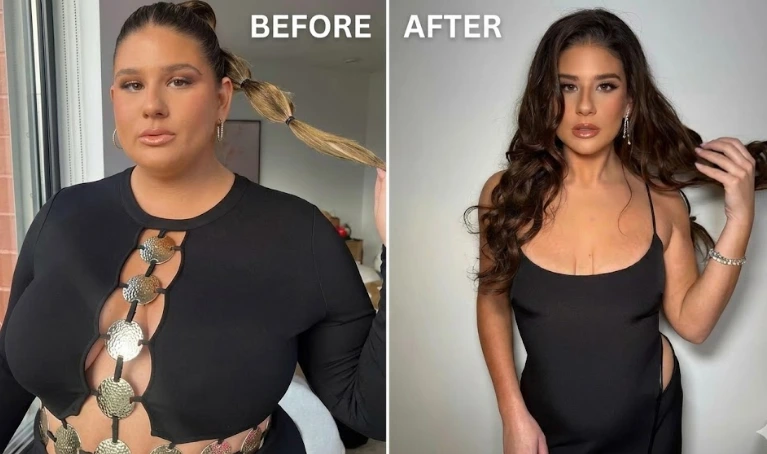
While Remi hasn’t disclosed her exact starting and ending weights, reports suggest she lost approximately 140+ pounds through the surgery and subsequent lifestyle changes.
Visible Transformation
Photos from early 2024 show Remi at her highest weight, wearing the plus-size clothing she’d become famous for styling. By early 2025, her appearance had changed dramatically—she appeared several sizes smaller, with a noticeably different body composition.
In April 2025, Remi addressed speculation that she’d also had skin removal surgery. She shut it down immediately, showing her stretch marks and surgical scars on Instagram to prove she hadn’t undergone additional procedures.
“I kind of wanted to see where my body ends up, I guess, before I do anything,” she explained about potentially considering skin removal in the future.
The Confusing Identity Shift
For Remi, the mental adjustment has been harder than the physical one.
“It’s really confusing to be in a different body but have the exact same brain,” she told Khloé Kardashian. “I never wanted to be this size.”
This statement shocked many followers. Here was someone who’d championed body positivity, saying she preferred her larger body. But Remi clarified that her surgery wasn’t about achieving society’s beauty standards, it was about saving her health.
“I’m lost,” she admitted. “I wasn’t big enough at first and plus-size enough at first for the plus-size community. Then I became too big for some brands even to work with. Now I’m too small? I actually don’t know where I’m supposed to be.”
Life After Surgery: New Realities
Remi’s life has changed in ways both positive and challenging. She has more energy than ever, fewer health problems, and her binge eating episodes have decreased dramatically—not because she overcame the disorder mentally, but because her stomach physically cannot accommodate large amounts of food anymore.
“I’m still struggling and I have those thoughts, but I can’t physically binge as much because I don’t have the room for it,” she explained.
Daily Life Adjustments
Her eating must follow strict rules:
30-Minute Rule: She cannot drink and eat within the same 30-minute window. If she does, she gets sick.
Small Portions: Her stomach can only hold a fraction of what it once could, requiring her to eat smaller meals more frequently.
Protein Priority: She must focus on protein-rich foods first to prevent muscle loss and malnutrition.
Vitamin Supplements: She’ll need to take vitamins and supplements for the rest of her life to prevent deficiencies.
Limited Alcohol: Alcohol absorption changes dramatically after SADI-S, making drinking risky.
Social Challenges
Going out with friends has become complicated. “Sometimes I’m out to dinner with friends, and I run to the bathroom,” she said. “I’m constantly getting sick” at events and dinners.
This aspect of her new reality rarely makes it into the polished Instagram posts showing her transformed body. The behind-the-scenes struggles continue even as the weight stays off.
Why Did Remi Keep It Secret for 15 Months?
From December 2023 when she had surgery until March 2025 when she finally revealed the truth, Remi endured constant speculation about her changing body. Comments ranged from “she’s definitely on Ozempic” to cruel accusations that she’d betrayed the body positivity movement.
So why stay silent?
Privacy and Healing
“I think I’ve let so many people take my power away for a long time,” Remi told SELF. “I will never regret having my time to heal, and I’m still healing and figuring it out. That was none of the internet’s business, these people that don’t know me, and that was for me to figure out.”
Fear of Judgment
As someone who built her brand on body positivity, Remi feared backlash. And she was right to worry, when she finally shared her story, reactions were mixed.
Some followers praised her honesty and bravery. Others accused her of hypocrisy, claiming she’d sold out the body positivity movement. The criticism hurt, but Remi maintains she made the right choice for her health.
Processing Her Own Feelings
Remi admits she had “a lot of regret” during recovery. “I was like, ‘Oh my God, I’ve been this person that people looked up to online for this whole time,'” she said.
She needed time to reconcile her public image with her private health crisis. The decision to have surgery didn’t mean she’d lied about loving her body before, it meant her body was literally failing her, requiring medical intervention.
Remi Bader’s Binge Eating Disorder
Central to Remi’s weight loss journey is her ongoing battle with binge eating disorder (BED), a serious mental health condition that affects millions of Americans.
What is Binge Eating Disorder?
BED involves recurring episodes of eating large quantities of food rapidly, often to the point of physical discomfort, accompanied by feelings of loss of control. Unlike bulimia, people with BED don’t purge afterward.
According to the National Eating Disorders Association, BED affects about 2.8 million Americans and is more common than anorexia and bulimia combined.
How Surgery Helped (and Didn’t Help)
SADI-S physically prevents Remi from consuming large amounts of food in one sitting. Her stomach simply can’t hold it. This has reduced her binge episodes, but it hasn’t cured the underlying psychological triggers.
“I’m still struggling and I have those thoughts,” she admits. The mental patterns that drove her to binge remain, even if she can’t act on them the same way.
This is why experts stress that bariatric surgery isn’t a magic fix. It’s a tool that must be combined with therapy, lifestyle changes, and ongoing mental health support for lasting success.
Ongoing Treatment
Remi continues working with a therapist to address the emotional and psychological aspects of her eating disorder. She takes medication for depression and anxiety. She exercises regularly with a trainer.
These elements are just as crucial to her transformation as the surgery itself.
The Body Positivity Debate
Remi’s weight loss has reignited discussions about body positivity, what it means, and who gets to claim it.
The Backlash
Some critics argue that by losing weight through surgery, Remi has abandoned body positivity principles. They see her transformation as confirmation that even body-positive influencers secretly want to be thin.
This interpretation misses crucial context. Remi didn’t lose weight to fit societal beauty standards or to become an Instagram model. She lost weight because doctors told her she was dying young.
The Defense
Supporters counter that body positivity means loving your body enough to take care of it—even if that means making changes when your health is at risk.
“My body was literally failing,” Remi emphasized. “I loved my identity as a curvy woman. I still do. But I also want to be alive and healthy.”
The Nuance
The reality is more complex than either side acknowledges. Body positivity isn’t about never changing your body. It’s about rejecting the idea that your worth is determined by your size.
Remi can love her body at any size while also recognizing when medical intervention becomes necessary for survival. These ideas aren’t contradictory, they’re complementary aspects of true body respect.
Expert Insights on SADI-S Surgery
Medical professionals who specialize in bariatric surgery provide important context for understanding Remi’s experience.
When is SADI-S Recommended?
Dr. Matthew Brengman, a bariatric surgeon at Jackson Health System, explains that SADI-S is typically recommended for patients with:
- BMI of 40 or higher (or BMI of 35+ with serious health conditions)
- Previous weight loss surgery that didn’t achieve desired results
- Severe obesity with metabolic conditions like diabetes or fatty liver disease
- Failed results from diet, exercise, and medication
Expected Weight Loss
Studies show SADI-S patients typically lose 70-80% of their excess weight within 18-24 months. For someone with 150 pounds of excess weight, that means losing 105-120 pounds.
Remi’s 140+ pound loss falls within this expected range, though her timeline is still ongoing.
Why Recovery Varies
While most patients have relatively smooth recoveries, about 5-10% experience severe complications like those Remi endured. Factors that increase complication risk include:
- Fatty liver disease (which Remi had)
- Higher starting BMI
- Pre-existing digestive issues
- Individual anatomical variations
Long-Term Success Rates
Research shows 85-90% of SADI-S patients maintain significant weight loss five years post-surgery, making it one of the most effective long-term options.
However, success requires lifelong commitment to dietary guidelines, vitamin supplementation, regular medical monitoring, and addressing psychological factors through therapy.
Lessons from Remi’s Journey
Remi’s transparency about her struggles offers valuable insights for anyone considering weight loss surgery or dealing with similar health challenges.
Surgery Isn’t Easy
“I don’t want people to go and run and get a surgery that I’m not fully advocating for,” Remi warns. “I’m saying, I think it helped me, but will it help me in a year? What if I gain all the weight back? What if I get sick from the [lack of] nutrients?”
She’s honest that she doesn’t have everything figured out, even after losing the weight.
Mental Health Matters
The psychological recovery is just as challenging as the physical one. Depression, anxiety, identity confusion, and ongoing eating disorder symptoms require professional support.
“I’m still healing and figuring it out,” Remi admits.
Health vs. Aesthetics
The motivation matters. Remi didn’t have surgery to look like a supermodel, she had it because her organs were failing. Understanding this distinction is crucial for making informed decisions about weight loss interventions.
Your Body, Your Choice
Despite public pressure to share every detail, Remi took 15 months to tell her story. She doesn’t regret prioritizing her healing over internet demands.
“That was none of the internet’s business, these people that don’t know me, and that was for me to figure out.”
Frequently Asked Questions
How did Remi Bader lose so much weight?
Remi Bader lost over 140 pounds through SADI-S bariatric surgery in December 2023, combined with dietary changes, regular exercise, and ongoing therapy for her binge eating disorder.
What medication did Remi Bader take to lose weight?
Remi tried Ozempic twice and Mounjaro once before surgery, but these medications only caused temporary weight loss (about 10 pounds) and severe nausea. She currently takes antidepressants and anxiety medication to support her mental health during recovery.
Which weight loss surgery did Remi Bader have?
Remi had SADI-S (Single Anastomosis Duodenal-Ileal Bypass with Sleeve Gastrectomy) on December 11, 2023. This procedure removes 70-80% of the stomach and reroutes the small intestine to reduce calorie absorption.
Final Thoughts
Remi Bader’s weight loss journey defies the neat narratives we expect from celebrity transformations. There’s no glossy montage of gym sessions, no simple “diet and exercise” explanation, and certainly no suggestion that surgery is an easy fix.
Instead, we see the messy reality: a young woman whose body was failing, who tried everything before resorting to surgery, who experienced brutal complications, who fell into deep depression, and who still struggles with the mental health issues that contributed to her weight gain in the first place.
Remi lost the weight, but she’s still healing, physically, mentally, and emotionally. She’s navigating a confusing new identity, dealing with changed relationships with food and her body, and processing the public’s reaction to her transformation.
Her honesty is a gift. In a world of filtered perfection and oversimplified health narratives, Remi’s willingness to share the brutal truth about weight loss surgery provides crucial perspective for anyone considering similar interventions.
Weight loss surgery isn’t about taking the easy way out. It’s a serious medical procedure with real risks, life-altering consequences, and no guarantees. For Remi, it was a necessary step to save her health. But she’d be the first to tell you: it’s been anything but easy.